
Why AI Recommends Your Competitor Instead of Your Store
Shoppers no longer scan twenty links — AI hands them one to three stores. Find out whether you’re one of them, and what actually decides that shortlist.
A year ago, your customer typed “best 40L trekking backpack” into Google.
Today they type something else. They type: “I need a trekking backpack for a four-day hike, I’m 5’9″, budget under $150. What do you recommend and where should I buy it?”
And they get an answer. Three specific models, three specific stores, prices, a summary of reviews, links.
Your store isn’t one of them.
Not because you slipped to position nine. Not because a competitor outbid you on Ads. You simply weren’t part of the conversation where the purchase decision was made — and that conversation happened without a single click on your site.
This article explains how that new decision layer works, why ranking well in Google no longer guarantees a place in it, and — more usefully — how to find out today, in about fifteen minutes, whether you’re in it at all.
What actually changed in the buying journey
The technology of search didn’t change. The moment of decision did. Shoppers used to decide on your site, after comparing a few product pages. Now a large share of them decide earlier, inside a conversation with a model, and arrive on your site already committed — just to complete the transaction.
The old path: query → list of links → your own comparison → choice.
The new path: a question in plain language → a finished recommendation → confirm or adjust.
This isn’t a 2028 forecast. A Semrush survey from December 2025 found that half of U.S. shoppers have already bought something after researching it with AI, and ChatGPT passed 900 million weekly active users in February 2026. This is mainstream behaviour, not early adoption.
What matters more for a store: these conversations end in products, not paragraphs. Analyses of shopping prompts in 2026 show that ChatGPT returns product cards on roughly 87% of shopping prompts, and Google AI Mode on roughly 91%. This isn’t an assistant that occasionally mentions a brand. It’s a shelf you’re either on or you’re not.
The shelf went from twenty slots to three
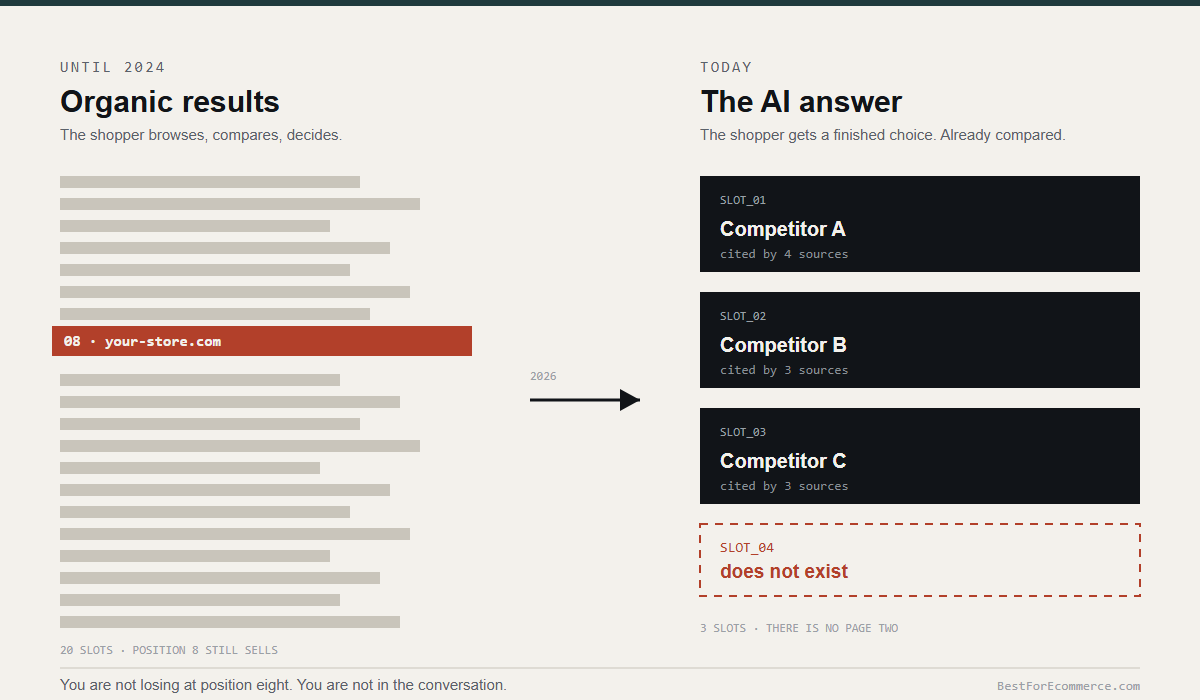
In organic results, position eight still sold something. In an AI answer, there is no position eight. The model typically returns one to three options, with no second page and nothing to scroll to. Visibility stopped being a gradient and became binary.
That’s the entire mathematics of this shift. In a twenty-link world, the long tail of exposure kept hundreds of mid-sized stores alive. In a three-slot world, that tail disappears.
The click data backs it up. Seer Interactive tracked more than 25 million organic impressions across 42 organizations and found that organic click-through rate on queries showing an AI Overview fell from 1.76% to 0.61% — a 61% drop. Paid CTR on the same queries fell further, down 68%. And the damage wasn’t confined to AI Overview queries: even searches without one lost 41% of their CTR over the same period.
Meanwhile, roughly 60% of Google searches now end without a click at all — and inside Google’s AI Mode that figure climbs above 90%.
Note the framing, because it matters: this isn’t a penalty applied to your site. It’s the difference between being cited and being skipped, on the same query, in the same instant.
Why ranking well in Google stopped being enough
Because appearing in an AI answer and ranking in classic results are no longer the same thing. In mid-2025, being in the top 10 gave you roughly a 75% chance of being used as a source in an AI Overview. By early 2026 that overlap had collapsed to somewhere between 17% and 38%.
In plain terms: you can hold the number one position for a query and not exist in the answer generated directly above it.
The reason is unglamorous — these are different systems weighing partly different signals. The summarizing model rewards unambiguous answers, complete data, and agreement between independent sources, rather than link authority alone.
Then there’s the finding that quietly undermines a lot of agency decks: the engines don’t behave alike. Ahrefs measured how strongly the number of brand mentions across the web correlates with AI visibility, and got ρ = 0.65 for Google AI Overviews — strong — but only ρ = 0.15 for ChatGPT. Effectively nothing.
The practical conclusion is uncomfortable but honest: there is no single lever you pull to “be in AI.” There are at least three ecosystems, each with its own logic for choosing sources.
Where AI gets your product data
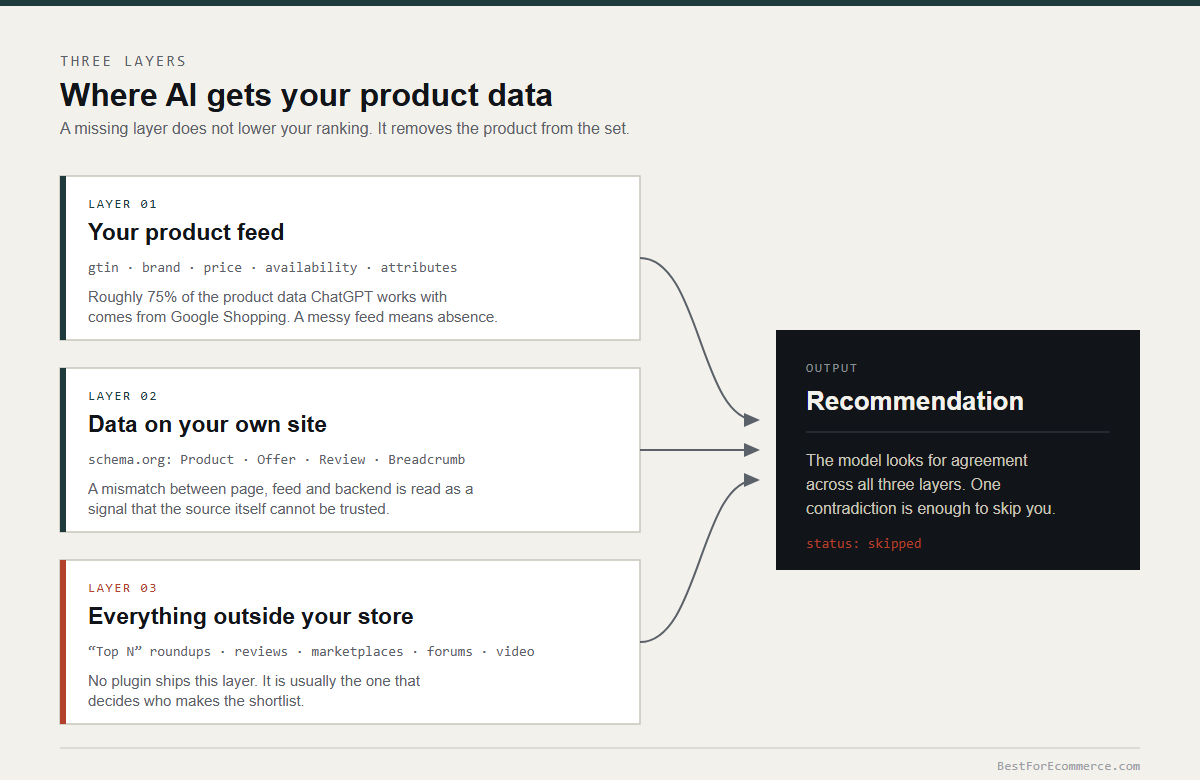
A product recommendation is assembled from three layers at once, and a gap in any one of them doesn’t lower your position — it removes the product from the set entirely. This is the single most important mechanic in this article.
Layer 1: your product feed
Models don’t read your store the way a human does. They reach for structured data. Around 75% of the product data ChatGPT Shopping works with comes from Google Shopping — which, in practice, means your Merchant Center feed.
And that’s where it usually breaks. Estimates from 2026 put roughly 60% of ecommerce catalogs in a state with missing GTINs, inconsistent attribute naming, or stale inventory status. Any one of those causes an agent to downgrade confidence in the product or drop it altogether — before offer comparison even begins.
Layer 2: data on your own site
The second layer is structured data in your page markup — Product, Offer, Review, Breadcrumb. This is a threshold, not an advantage. Without it, a model either skips the source or reads it in fragments.
More dangerous than absence, though, is disagreement between layers. When your on-page JSON-LD says one thing, your Merchant Center feed says another, and your backend says a third, the system doesn’t pick the most credible one. It reads the contradiction as evidence that the source is unreliable — and moves on to a competitor.
If a customer has ever emailed you saying “the AI quoted a different price than your site,” that wasn’t an anecdote. That was an audit report.
Layer 3: everything outside your store
And this is the layer that makes most store owners sit up.
No single source decides whether you get recommended. What decides it is a pattern of agreement across many independent sources. An industry roundup, marketplace reviews, a forum thread, a video review, a comparison in trade media — when unrelated places say the same thing about the same brand for the same use case, the model treats that as consensus. And only then does it recommend confidently.
Your own site is one voice in that. An important one, but one.
What generative search actually cites
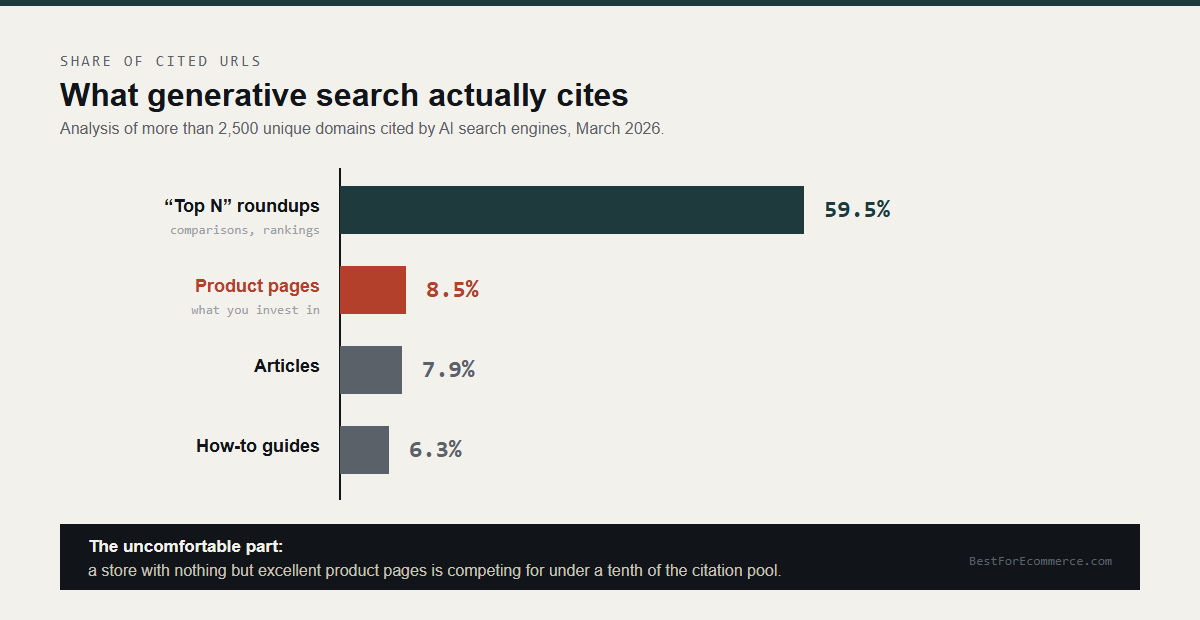
Here it gets uncomfortably specific. An analysis of more than 2,500 unique domains cited by AI search engines (March 2026) produced this breakdown by content type:
| Content type | Share of cited URLs |
|---|---|
| “Top N” roundups and rankings | 59.5% |
| Product pages | 8.5% |
| Articles | 7.9% |
| How-to guides | 6.3% |
A store that has invested exclusively in excellent product pages is competing for under a tenth of the citation pool.
It also explains how brands without large budgets suddenly surface in recommendations: they didn’t win on links. They won by existing inside comparison content.
The same mechanic shows up in query fan-out — when a model receives a shopping prompt, it breaks it into its own sub-queries. The terms it most often adds are “best,” “review(s),” “top,” “comparison,” “vs,” and the current year. Those aren’t keywords to sprinkle into copy. They’re a list of content formats that have to exist around your products — either yours or somebody else’s.
The test: check in 3 minutes whether AI recommends you
Enough theory. This is the one section you should actually act on today, because until you see the result yourself, this stays an abstract trend.
Step 1. Write down 10 real customer questions.
Not keywords. Questions. Pull them from emails, live chat, phone calls, product Q&As. They need to sound like sentences people actually type — with context of use, a budget, and a constraint.
Weak: 40l trekking backpack
Strong: What’s a good 40L trekking backpack for four days in the mountains, for someone 5'9", under $150?
Step 2. Run them through three engines.
ChatGPT, Google AI Mode (or Gemini), and Perplexity. Separately. Ideally in a logged-out window with history off — otherwise you’re testing your own bubble, not the market.
Step 3. Count three things.
| What you count | Why it matters |
|---|---|
| How often your store or brand appears | This is your real share of the shelf |
| Which brands appear more often than you | This is your competitor set as the market defines it, not as you do |
| Which sources are cited under the answer | This is the map of places you need to be in |
Step 4. Check the data, not just the presence.
If you do appear, verify that the price, availability and specs quoted are correct. Wrong data can be worse than absence — the shopper arrives with a false expectation and leaves annoyed.
One honest caveat: results vary. Recommendations differ by country, by category and between sessions — in some categories the same brands recur everywhere, in others the picture changes market by market. A single test is a signal, not a verdict. But if you appear zero times across ten prompts while a competitor appears seven, that’s no longer statistical noise.
Four common reasons you get left out
- Your products aren’t machine-readable. Missing GTINs, empty attributes, specs buried in images, inventory synced once a day. A store can look excellent to a human and be effectively invisible to a system that reads nothing but data.
- You have no comparison content. No roundups, no rankings, no “X vs Y” on your domain. When 59.5% of citations go to those formats, you have nothing to enter with.
- You don’t exist outside your own domain. No reviews off-site, no mentions in trade media, no presence where people actually discuss your category. The model has nothing to check your own claims against.
- Your data contradicts itself. One price on the page, another in the feed, another on the marketplace. This is the quiet killer almost nobody talks about, because it shows up in no report you currently read.
Reason #1 is the one you can fix today
Our free checker scans your store’s structured data and crawler permissions — the exact layer behind reasons #1 and #4 above — and shows you precisely what’s missing. Free, no signup, about 60 seconds.
Check Your Site’s Visibility in AI Models
You’ll get a clear pass/fail list, not just a score.
Where to start — the order matters more than the list
Sequence matters more than scope here, because the first two items determine whether the rest is worth doing at all.
- Fix product data and structured data. Lowest cost, fastest effect, entirely within your control. This is the entry ticket — without it, everything else has nothing to stand on.
- Make the layers agree. Site, feed and backend should say exactly the same thing about price, availability and specs. Daily, not quarterly.
- Build content that answers multi-constraint questions. Roundups, comparisons, “who this is for and who it isn’t.” This is the only element that can work quickly — fresh content can start earning citations within three to five days of publication.
- Only then work on presence in third-party sources. Slowest and most expensive, but also the most durable — and ultimately the thing that decides who makes the shortlist.
Running that list backwards is the most common and most expensive mistake: stores start with PR and outreach while sitting on a feed that excludes their products anyway.
What no tool and no agency can promise you
Since this whole article runs on urgency, you’re owed the other side of the ledger.
There is no guarantee of placement in an AI answer. “Rank #1 in ChatGPT” isn’t a thing. Neither is a Search Console for language models — you will not get a dashboard showing your impressions and clicks from recommendations.
The systems themselves aren’t reliable either. 2026 analyses put ChatGPT’s product recommendation accuracy at around 64% on standard queries and around 52% on multi-constraint ones — meaning roughly every second complex recommendation misses.
So what can you reasonably expect? Not guaranteed presence. The removal of the reasons a model skips you. That’s a real, executable, checkable scope of work — and the first two items on the list above can be done without an agency, without a subscription, and without changing platforms.
One more thing worth holding onto before you file this under “later.” There’s a good chance this channel is already earning for you and you can’t see it: research on AI referral traffic found that 70.6% of it arrives with no referrer header, landing in GA4 as “direct.” Meanwhile, an analysis of 94 ecommerce stores found ChatGPT traffic converting at 1.81% versus 1.39% for non-branded organic, with 10.3% higher revenue per session. The volume is still small. The quality isn’t — and the reporting gap is exactly why most owners haven’t noticed the shift yet.
Frequently asked questions
Does GEO replace SEO?
No. Classic SEO remains the foundation — your store still has to be fast, crawlable and sensibly structured. GEO is a layer on top that determines citability. Without the foundation, the layer has nothing to attach to.
Can a small store compete with marketplaces here?
Yes, within limits. Models reward data completeness and source consensus in a specific niche, not size alone. A 200-product store with immaculate data can be recommended more often than a large store with a messy feed — but only in categories where it genuinely is the specialist.
How long does it take?
Cleaning up product and structured data: days. Comparison content: first citations possible within three to five days of publishing. Presence in third-party sources: months, because it compounds.
Do I need to run a blog?
You don’t need a blog. You need comparison content — and those aren’t the same thing. A dozen well-made roundups and comparisons in your category will do more than two years of unfocused posts.
Why does ChatGPT quote my old price?
Usually because the model is working from the last state it saw in structured data — most often your feed. Check how often that feed refreshes, and whether price agrees across your page, your markup and Merchant Center.
Is it enough to optimize for one platform?
ChatGPT has the largest share, so it’s a reasonable starting point. But engines weigh different signals — what lifts you in Google AI Overviews may do nothing in ChatGPT. Treat them as separate channels, not as one bucket called “AI traffic.”
Take the first step today
The test above tells you whether you’re missing. Our free checker tells you why — which specific gaps in your store’s structured data and crawler permissions cause a model to skip you.
Check Your Site’s Visibility in AI Models
Enter your URL. No signup. Results in under a minute.
Sources: Seer Interactive CTR study (25M+ organic impressions, 42 organizations) · Semrush consumer survey, December 2025 · Ahrefs AI visibility correlation studies · content-type citation analysis of 2,500+ domains, March 2026 · AI referral conversion analysis across 94 ecommerce stores (Visibility Labs) · AI referral attribution dataset, February 2026.