
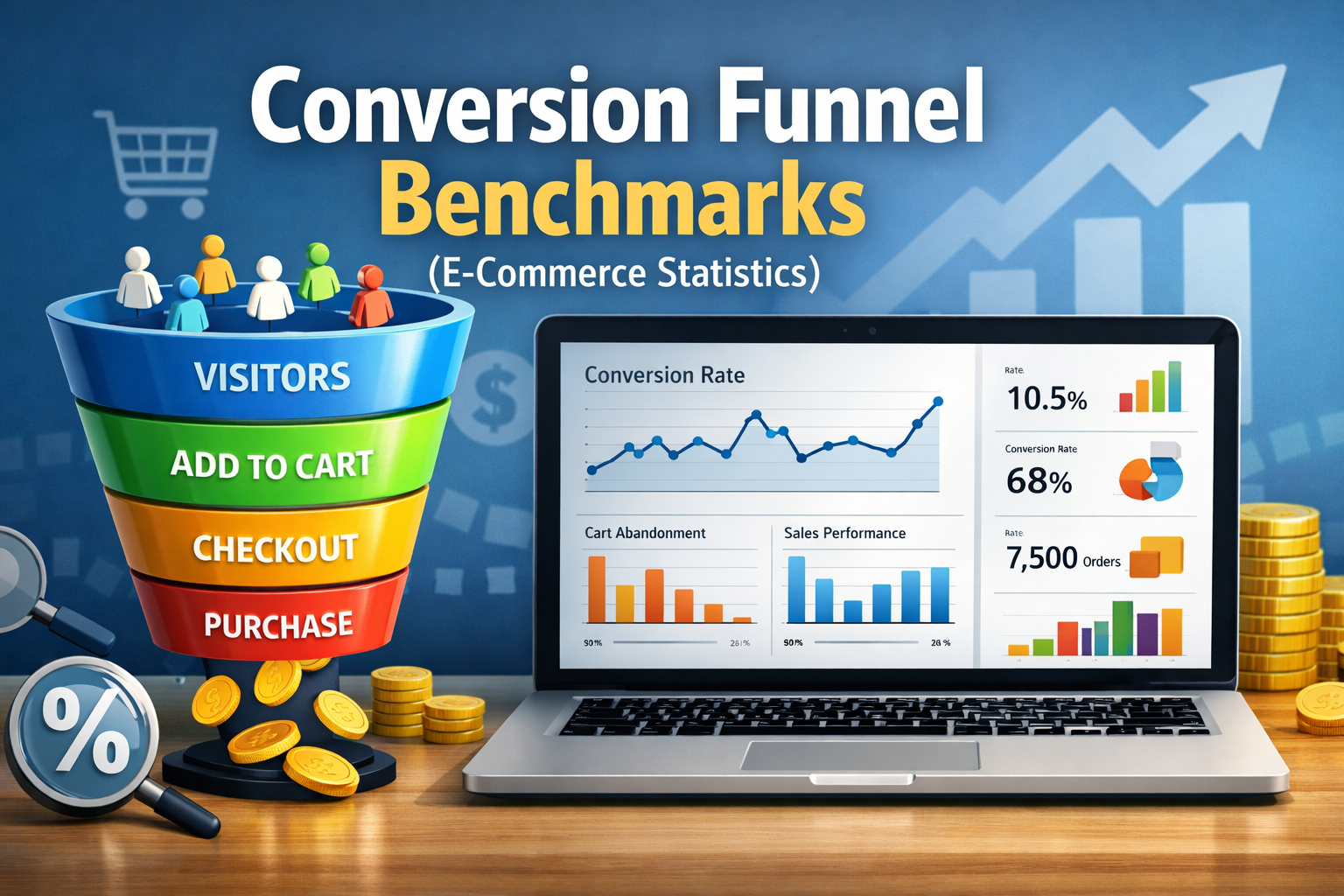
Conversion funnel benchmarks help you compare how efficiently an online store turns visitors into buyers.
This silo groups the core e-commerce funnel metrics used in CRO audits, growth reports, performance reviews, and research:
conversion rate, cart abandonment, checkout performance, average order value, device-level conversion, and source-level conversion.
Back to the main hub:
E-commerce Statistics.
For definitions and comparison rules, start with
Methodology.
If you need the core funnel benchmark set first, use
conversion rate benchmarks,
cart abandonment rate,
and average order value benchmarks.
Core conversion funnel benchmarks
Start with these three pages when you need a compact, citation-ready view of e-commerce funnel performance.
E-commerce Conversion Rate Benchmarks
Baseline conversion rate benchmarks with a consistent definition, source context, and practical interpretation.
Cart Abandonment Rate
Benchmark abandonment rate, common reasons shoppers abandon carts, and context for checkout analysis.
Average Order Value (AOV) Benchmarks
AOV benchmark ranges that add revenue context beyond traffic and conversion rate alone.
Funnel benchmarks are easier to interpret with device and traffic context. Pair this silo with
mobile share of traffic,
mobile share of revenue,
and traffic and marketing performance statistics.
Conversion funnel dataset map
Use this table to choose the right metric for CRO analysis, revenue reporting, or benchmark comparisons.
| Dataset | What it measures | Best used for |
|---|---|---|
| E-commerce Conversion Rate Benchmarks | The share of visits, sessions, or users that turn into purchases. | Store performance benchmarking, CRO audits, and conversion reporting. |
| Cart Abandonment Rate | The share of shoppers who add items to cart but do not complete purchase. | Checkout friction analysis, cart UX reviews, and revenue recovery estimates. |
| Average Order Value Benchmarks | Average revenue generated per order. | Revenue modeling, merchandising analysis, bundles, upsells, and pricing context. |
| Add-to-cart Rate Benchmarks | The share of visitors or sessions that add at least one item to cart. | Product page performance, offer quality, merchandising, and PDP diagnostics. |
| Checkout Abandonment Rate | The share of users who start checkout but leave before completing the order. | Checkout UX, payment friction, shipping cost analysis, and form simplification. |
| Checkout Completion Rate | The share of checkout starters who complete the transaction. | Payment flow reporting, checkout optimization, and purchase intent analysis. |
| Time to Purchase Benchmarks | How long it takes shoppers to move from first visit or first touch to purchase. | Customer journey analysis, retargeting timing, and funnel length comparisons. |
| Sessions to Purchase Benchmarks | How many sessions usually happen before an order is placed. | Attribution context, remarketing strategy, and buying-cycle analysis. |
| Conversion Rate by Device | Conversion differences between mobile, desktop, tablet, and other devices. | Mobile UX analysis, device-level CRO, and revenue gap diagnosis. |
| Conversion Rate by Traffic Source | Conversion performance by channel, source, or campaign type. | Marketing performance reviews, channel quality analysis, and traffic mix reporting. |
| Top Funnel Drop-off Points | Where users most often leave the shopping journey before purchase. | Prioritizing CRO work, UX fixes, checkout changes, and funnel diagnostics. |
What this silo covers
Conversion funnel statistics connect user behavior with revenue outcomes. They should not be read as isolated numbers.
Purchase conversion
Metrics that show how often visitors, users, or sessions turn into orders, including total conversion rate and conversion by device or source.
Cart and checkout friction
Metrics that show where purchase intent breaks down, including cart abandonment, checkout abandonment, and checkout completion rate.
Revenue per order
AOV benchmarks help explain whether revenue growth is coming from more buyers, larger orders, or both.
Journey depth and timing
Sessions to purchase and time to purchase help explain how long shoppers take to decide and how many visits often happen before conversion.
How to use conversion funnel benchmarks
Use these checks before comparing your store, client, or cited source against a benchmark.
-
Check the denominator.
Conversion rate can be calculated using sessions, users, visitors, or orders divided by another traffic measure. Do not compare numbers unless the denominator is clear. -
Separate cart abandonment from checkout abandonment.
Cart abandonment starts earlier in the funnel. Checkout abandonment usually means stronger purchase intent and different causes. -
Compare like-for-like.
Device mix, category mix, AOV, country, traffic source, and brand intent can materially change funnel benchmarks. -
Read CR with AOV.
A higher conversion rate is not always better if average order value or margin falls at the same time. -
Add supporting context.
Payment methods, delivery options, mobile UX, page speed, and traffic quality often explain why one funnel performs differently from another.
Reference pages:
Methodology •
Glossary •
Sources
Key definitions
Short definitions for the most important funnel terms used across this silo.
Conversion rate is the share of traffic, sessions, users, or visitors that complete a target action, usually a purchase in e-commerce reporting.
Cart abandonment rate measures the share of shoppers who add items to the cart but do not complete the order.
Checkout abandonment rate measures the share of shoppers who begin checkout but leave before completing payment.
Average order value (AOV) is total revenue divided by number of orders for a defined period, segment, or channel.